



 EN
·
EN
·  DE
DERobust engraving and polishing across depth, even on a tilted surface.
Fine laser engraving and polishing lives and dies by surface quality. As soon as a feature spans a range of depths, the industry’s problem is holding onto that quality without stepping through different Z positions. A flat-top that stays in shape through the depth of focus makes it possible in a single scan. To benchmark it, we ran a deliberately hard case with our partner LANG: a 10 × 10 mm surface tilted by ~8° (1.34 mm height difference), and a far larger area stayed in spec in one pass.
- Fine engraving & polishing needs high surface quality across features that sit at different depths, ideally in one scan, without re-focusing to several Z positions
- A conventional top-hat holds spec over only a small focus window, so anything off the focal plane falls out of spec
- Benchmark case: a 10 × 10 mm surface tilted ~8° (1.34 mm height difference), a controlled stand-in for that depth spread, on an F100 mm scanner at 1030 nm, fs pulses
- >3× larger process window — a much larger stable region across the tilt
- >2× better surface quality — Sa 0.4 µm vs. 0.9 µm, Sz 2.6 µm vs. 5.8 µm
- Polished Z-regime ~530 µm vs. ~180 µm for a standard top-hat
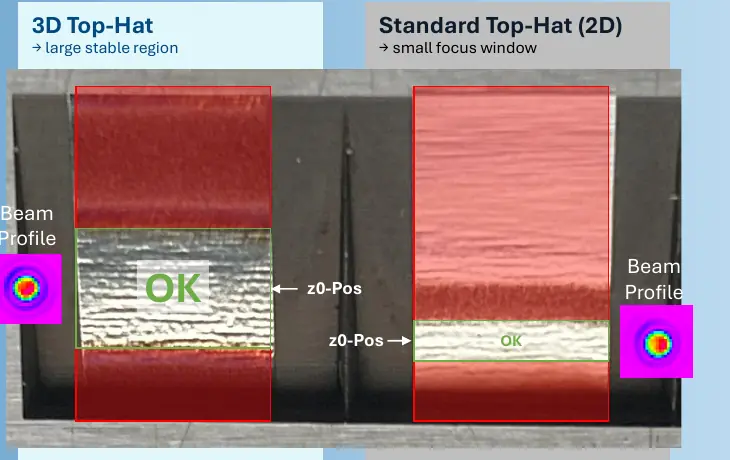
The numbers on a tilted surface
>3× process window
Polished Z-regime ~530 µm vs. ~180 µm for a standard top-hat, a far larger stable region across the tilt.
>2× surface quality
Roughness Sa 0.4 µm vs. 0.9 µm and Sz 2.6 µm vs. 5.8 µm, a measurably finer polished finish.
Robust in production
The same recipe holds across the height variation of a tilted part: fewer re-runs, more predictable quality.
Measured with LANG on a 10 × 10 mm part with 1.34 mm height difference. Values are configuration-specific and confirmed per setup.
Product & further use cases
Have a similar engraving challenge?
Tell us your laser and application. We’ll assess feasibility and start your first project together.
Discuss your challenge