



 EN
·
EN
·  DE
DE1 Your system
Must be greater than 0
Must be greater than 0
Must be greater than 0
Model is valid for M² 1.00 – 1.30
Standard Ø
Standard λ
—
aperture ≥ —
2 Your 3D Top-Hat Midel model
Spot Ø (1/e²)
—
—
Effective depth of focus
—
—
Without a beam shaper the same lens gives you: spot Ø —·DOF —·zR —
Standard specifications guaranteed on every unit
| Efficiency | ≥ 85% (Encircled energy (1/e⁴) / Total Energy) |
| Top-Hat Quality | Plateau Uniformity ≤ 0.1 and Flatness ≥ 0.9 (ISO 13694) |
| Strongest Side Order | Intensity ≤ 5% (relative to Top-Hat plateau) |
| Output Shape | Round Top-Hat (Gaussian to Top-Hat Conversion) |
| Angle of Incidence | 45.0° |
| Coating | >99.9% at 45.0° – Dielectric HR Coating on flat fused silica substrate |
Definitions, assumptions & chart notes
What a 3D Top-Hat does
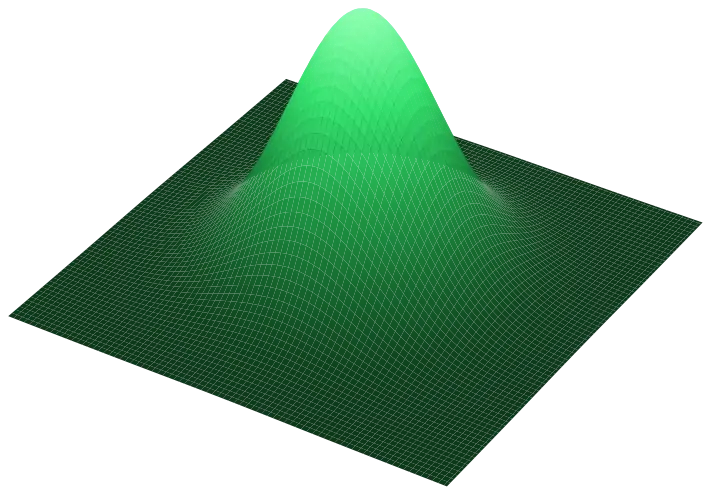
A focusing lens turns your Gaussian beam into a Gaussian spot — bright in the
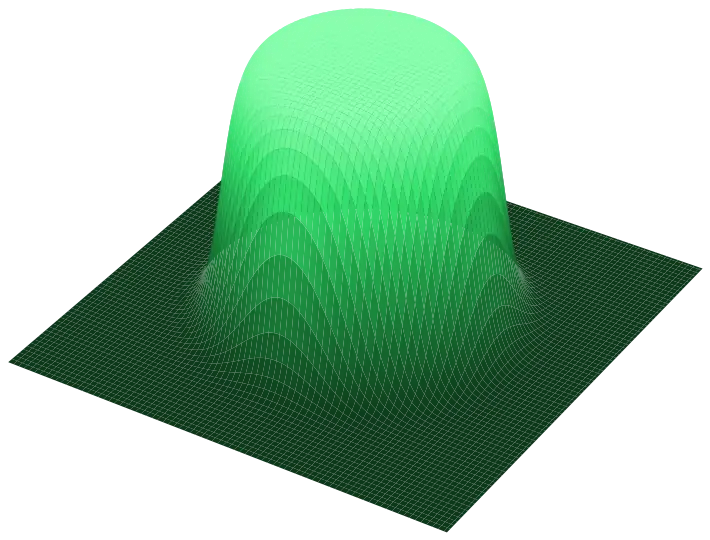
middle, tapering off towards the edge. A 3D Top-Hat replaces that with a round,
flat-topped spot: uniform fluence across the plateau, steep edges, and no strong side orders.
The spot gets larger than the unshaped focus, and it holds its shape over a defined depth
range. Those two numbers are what this calculator gives you.
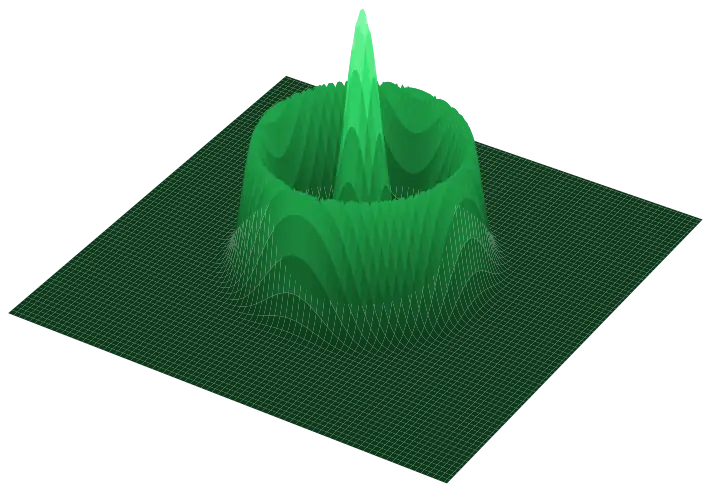
3D Top-Hat is part of Midel’s 3D-EDOF (Extended Depth of Focus) portfolio,
alongside 3D Gaussian and 3D Ring-Core.
Reading the charts
Both charts are schematic, drawn to scale — not a physical simulation.
They illustrate the calculated numbers and the guaranteed specification; every design is
simulated and confirmed individually before quotation.
Spot cross-section — both profiles are drawn to scale in the transverse
axis and normalised to the same peak, so the graphic compares width and shape, not
absolute intensity. The flat-top edge is drawn exactly as steep as the Gaussian flank:
a focused flat-top is diffraction-limited by the same optics, so its edge is not sharper than
the unshaped focus. The plateau and the ≤ 5 % side-order level illustrate the guaranteed
specification.
Depth of focus — the two ranges are the calculated numbers above, drawn
on one common z-axis. A flat-top profile holds its uniformity over a shorter range than a
Gaussian holds its diameter. The two criteria are different, so read each bar against its own
definition rather than as a ratio.
Every 3D Top-Hat is individually simulated and confirmed before quotation —
treat the numbers here as a first estimate, not as a specification.
Your inputs
Wavelength λ — the laser wavelength. Standard products cover
343–355 nm, 515–532 nm and 1030–1064 nm.
Input beam Ø (1/e²) — beam diameter at the shaper plane, 1/e² intensity
definition. Standard sizes are 2.5, 5 and 8 mm.
Beam quality M² — how close your beam is to a perfect Gaussian
(M² = 1 is perfect). This model is valid for M² 1.00 – 1.30; outside that range we
assess your case individually.
Focal length f — effective focal length of the focusing optic
(thin-lens approximation).
The Gaussian reference
Spot Ø (1/e²) — the focus you would get from the same lens without a
shaper:
d₀ = 4·λ·f·M² / (π·D).Rayleigh length zR —
zR = π·w₀² / (M²·λ)
with w₀ = d₀/2. The distance from focus at which the beam diameter has grown
by √2 — about 41 %.DOF (2·zR) — the classic textbook depth of focus, twice the
Rayleigh length.
The 3D Top-Hat result
Top-hat spot Ø (1/e²) — diameter of the round flat-top spot, derived
from the Gaussian reference through Midel’s measured design model. It is always larger than
the unshaped focus; that is the trade-off you pay for a uniform profile.
Effective depth of focus — the z-range over which the top-hat holds its
specified profile, also from the design model. It is not the same criterion as the
Gaussian 2·zR (diameter growth) — a flat top is judged on uniformity, which is the
stricter test.
Minimum clear aperture — every aperture in your beam path (scanner
mirrors, focusing lens, whatever comes last) should be at least
2 × D. Go smaller
and the numbers here stop holding.Assumptions & limits
Performance values are specified for a TEM₀₀ Gaussian input with
diffraction-limited wavefront quality at the DOE plane (λ/10 RMS or better) and sufficient
clear aperture.
Standard product availability requires both a standard input beam Ø
(2.5 / 5 / 8 mm, ±0.05 mm) and a wavelength inside one of the three standard bands.
Anything else is a custom design — still feasible, just not off the shelf.
Every design is individually simulated and confirmed before quotation. Treat
the numbers here as a first estimate, not as a specification.