



 EN
·
EN
·  DE
DEAdditive Manufacturing
One beam, two zones: better melt pools by design. A passive, all-reflective ring-core mirror lets you shape the melt pool instead of fighting it, with no laser redesign required.
The single-mode spot got LPBF this far. Beam shape is the next lever.
Metal additive manufacturing was industrialised on a good idea: put a near-diffraction-limited Gaussian spot on the powder bed and control it precisely. In laser powder bed fusion (LPBF, melting metal powder layer by layer with a scanned fibre laser, typically around 1070 nm), a single-mode spot gives you the finest features, the sharpest contours, and a melt pool that responds predictably to power and scan speed. When throughput had to rise, the levers were obvious and they worked: more power, faster scanning, then more lasers sharing one build area. That is how LPBF reached serial production, and for a great many parts it is still the right answer.
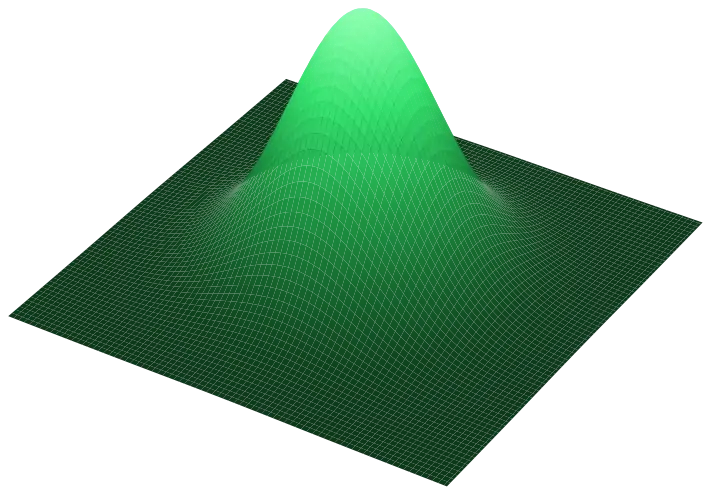
The ceiling appears where those levers stop being independent. A Gaussian puts most of its energy into a narrow central peak, so raising power and speed together drives the melt pool out of stable conduction melting and into keyhole mode, where the vapour depression fluctuates and traps porosity. Fraunhofer ILT names the same root cause: power concentrated in the beam centre causes local overheating and evaporation, and with it spatter and pores. Adding lasers routes around the physics rather than changing it; as Nikon SLM Solutions’ Benjamin Haas puts it, more lasers “does not automatically equate to lower cost-per-part, higher productivity, or the same part quality.” Beam shape is the one variable that widens the process window itself, instead of buying more of a narrow one. That’s why it matters most for the alloys a peaked Gaussian handles worst: refractory, crack-prone and highly reflective.
- Keyhole porosity — at high power and scan speed the vapour depression becomes unstable and traps gas, producing exactly the sub-surface defect fatigue-critical parts are rejected for
- Spatter, balling and soot — the steep thermal gradient around a peaked spot throws ejecta onto the bed and contamination onto the window, and in multi-laser machines carries from one melt pool into a neighbour’s beam path
- A melt pool that moves with focus — melting mode in LPBF is set by focal position, so scan-field position, build height and powder-bed flatness all show up as part-to-part variation
Control the melt pool, not just the power
Melt, don't vaporize
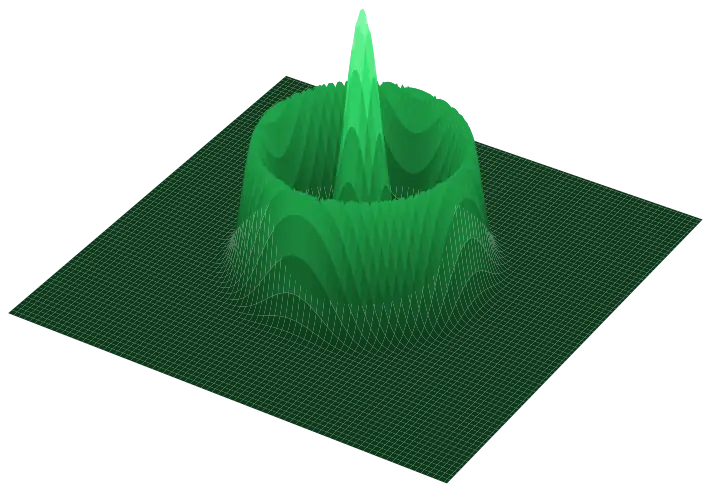
A hot core delivers the energy density for full fusion, while a surrounding ring pre-heats and tails off the thermal gradient, avoiding vapor-driven keyholing.
Cooling rate, under your control
The ring/core power ratio is customizable — a direct lever on grain structure, porosity and residual stress, without touching laser hardware.
Consistent from first layer to last
The dual-zone profile stays stable across ~100% of the depth of focus and resists thermal lensing, without drift as the build progresses.
Designed for 266 nm–1070 nm+, fs-pulsed to CW, including the 1064/1070 nm fibre lasers standard in LPBF. All-reflective, passive, and shipped worldwide from Bonn, Germany.
The laser additive manufacturing landscape — and where beam shape is the lever
Laser additive manufacturing spans a wide range of processes — powder bed or directed energy — and each one lives or dies by melt-pool control. Below is the landscape as we see it, and for a growing number of these we help customers find and build the beam shape that fits.
Laser powder bed fusion (LPBF / SLM / PBF-LB)
A scanned laser selectively melts metal powder layer by layer in a bed — the highest-resolution laser AM process. Industrial systems typically run fibre lasers at 1064–1070 nm from a few hundred watts to ~1 kW through a galvo scanner, which is exactly where a beam shaper sits.
Directed energy deposition (DED)
Powder or wire is fed into a melt pool created on an existing surface, so the part builds up without a powder bed. Larger spots, deeper melt pools and far higher deposition rates than LPBF — at lower resolution.
Laser metal deposition (LMD)
The powder-fed form of DED. A coaxial nozzle delivers powder into the beam focus, which makes the intensity distribution across the spot the main lever on dilution, catchment efficiency and bead geometry.
Wire-laser metal deposition (wire DED)
The wire-fed form of DED. Near-100% material utilisation and high deposition rates on large, simpler geometries — but wire feed is unforgiving, and a beam profile that keeps the wire tip melting stably is what separates a smooth bead from stubbing and dripping.
Laser cladding
Deposits a wear- or corrosion-resistant layer onto an existing part. The goal is inverted from LPBF: you want the coating fully fused but the substrate barely melted, so controlling peak intensity — not just total power — is the whole game.
Multi-laser / multi-beam LPBF
Several independently scanned lasers work one build simultaneously to raise throughput. It scales area coverage, not the process window — so overlap stitching, scan-field calibration drift and spatter carried from one melt pool into another beam become the limiting factors.
Built for melt-pool control
3D Ring-Core Shaper
A ring around a core, stable across the full depth of focus: calmer keyhole, less spatter.
Explore → Flat-Top for multimode lasersBeam Homogenizers
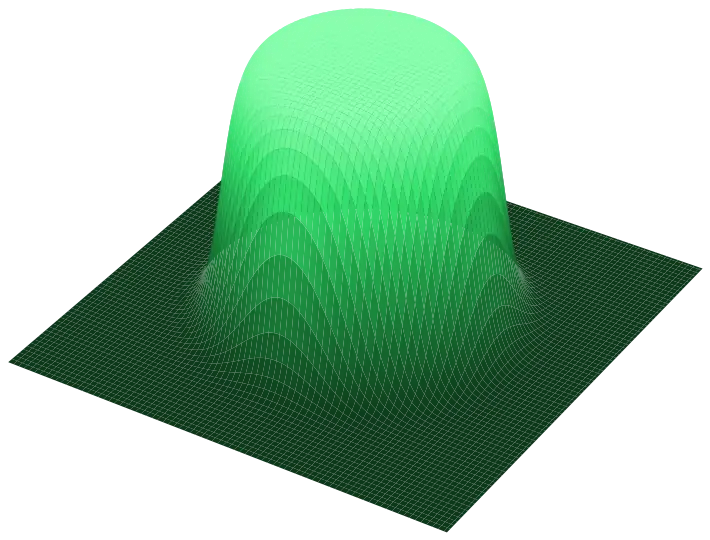
Turns a multimode fiber-laser beam into a uniform flat-top — the workhorse for hardening, welding and cladding.
Explore →A passive mirror that drops into an existing scanner beam path, with no new cooling or controls integration. The fit-check shows the parameters we design against.
Related use cases
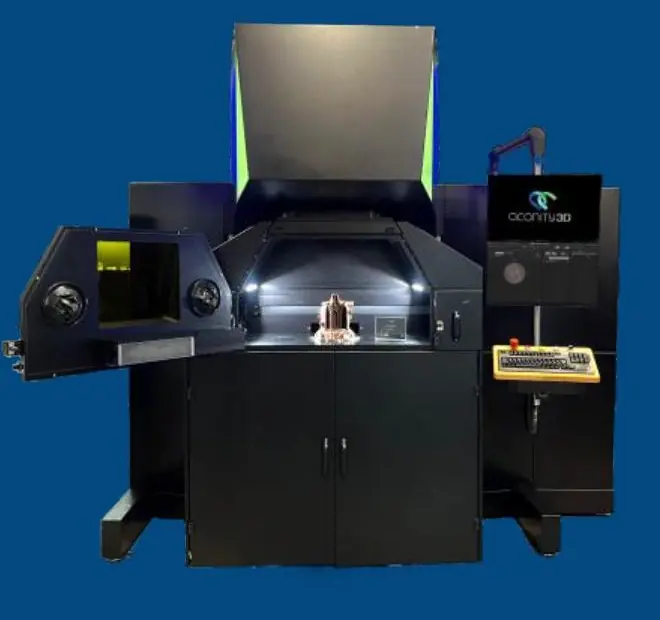
Additive manufacturing (LPBF)
Faster build-up with exchangeable beam shaping in the scanner path.
Read use case →Give your LPBF platform a melt-pool advantage.
Talk to us about integrating the 3D Ring-Core Shaper into your scanner path: a passive, drop-in optic your engineering team can evaluate in days, not quarters.
Discuss your challenge