



 EN
·
EN
·  DE
DEFrequently asked questions
Answers to what engineers ask us most — searchable, and grouped by topic.
Customization 5
Can I choose the number of spots and the pattern?
Can I combine it with a flat-top or other shaper?
Can I set the ring diameter and the ring-to-core power ratio?
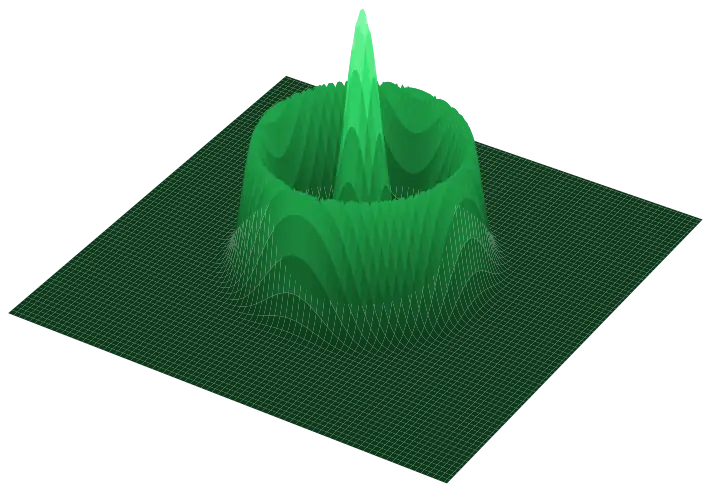
Yes, both are customized as standard. Tell us your target ring diameter and how you’d like power split between ring and core, and we design the optic around your process.
What shapes and sizes can I get?
What size and shape can I get?
Delivery & commercial 2
Does this scale to a few hundred units a year?
What’s the delivery time?
Custom optics are typically delivered within three weeks, depending on configuration.
Fundamentals 7
Does it change the beam I already use?
How does the homogenization actually work?
How is this different from a conventional top-hat?
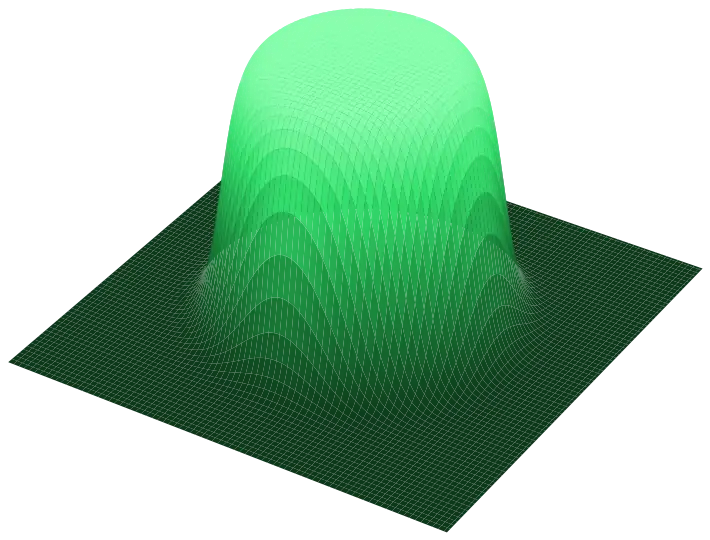
A conventional flat-top DOE only works for a single focal plane and decays into a gaussian as soon as you defocus. The 3D Top-Hat is engineered for depth of field instead: it holds a homogenized flat-top across an extended usable range around focus (up to ±60% of the Rayleigh length), giving you a much wider, more forgiving process window in production.
How is this different from a standard etched DOE?
How is this different from the Top-Hat Beam Shaper?
What’s the difference between the 2D and the 3D Top-Hat Shaper?
Why does the focal plane matter so much?
Integration & setup 7
How do I integrate it into an existing machine?
How do I integrate it?
How do I integrate it?
How do I integrate it?
It’s an all-reflective optic typically at 45° angle of incidence, so in most heads it simply replaces a fold or deflection mirror — no extra track length. It can sit before a focusing lens (parallel/Z-folded), in a folded path, or ahead of a scanner and F-Theta lens. It cleans like a standard mirror.
How do I integrate it?
We recommend a collimated beam with a focusing lens; the shaper can sit in a parallel/Z-folded, folded, or scanner (F-Theta) path. Lateral alignment is required. For setups without a lens, contact us for analysis.
How do I integrate it?
How much alignment does it need?
Laser compatibility 6
Does my beam quality (M²) matter?
Which lasers and power levels does it support?
All of them: deep-UV to near-IR, femtosecond to continuous-wave, and low power up to 50 kW+. It works with single- or multi-mode sources. Send your wavelength, power/regime, M² and input beam and we confirm fit.
Which lasers does it work with?
Which lasers is it compatible with?
A Gaussian TEM₀₀ source with M² ≤ 1.3, from CW to 300 fs pulses, at 1030–1064, 515–532 or 343–355 nm (others on request). Send us your wavelength, regime, M² and input beam diameter and we confirm fit.
Why do you need my BPP?
Will it work with my wavelength and laser type?
Performance & specifications 8
Does the structuring lower the damage threshold?
How efficient is it?
How much can it extend the depth of focus?
How much larger is the process window, really?
Up to about 5×. In production practice a regular shaper delivers a quality flat-top only within roughly ±12.5% of the Rayleigh length; the 3D Top-Hat holds flatness >0.9 and uniformity <0.1 across ±60%. The exact figure is M²-dependent — use our interactive calculator to check it for your system.
How small a flat-top can I get?
Down to about 1.5–1.8× the diffraction-limited spot, depending on beam quality — close to the physical resolution limit, which is what next-gen micro-machining needs.
How uniform are the sub-beams?
I have a 20 µm Gaussian spot. Can I get a 20 µm flat-top?
Will it survive multi-kW operation?
That’s a core strength. The optic is all-reflective (a micro-structured dielectric HR coating on fused silica with >99.9% reflectivity), so it stays stable where transmissive optics drift under thermal lensing.
Reproducibility & validation 3
Can I actually reproduce the measured numbers?
Yes, the values on this page were measured on a Primes MicroSpotMonitor MSM+ and agree with theory. We confirm the numbers for your exact configuration and stay close while you validate them in your process.
Can I actually reproduce the specifications?
Yes — that’s the point. Measured profiles match simulation and stay top-hat across ~60% of the depth of focus. We don’t ship catalogue parts with lab-only numbers; we support you through integration and stay close while you validate the profile under your real process conditions.
Can you give me exact specifications?
No questions match your search.