



 EN
·
EN
·  DE
DETop-Hat Beam Shapers
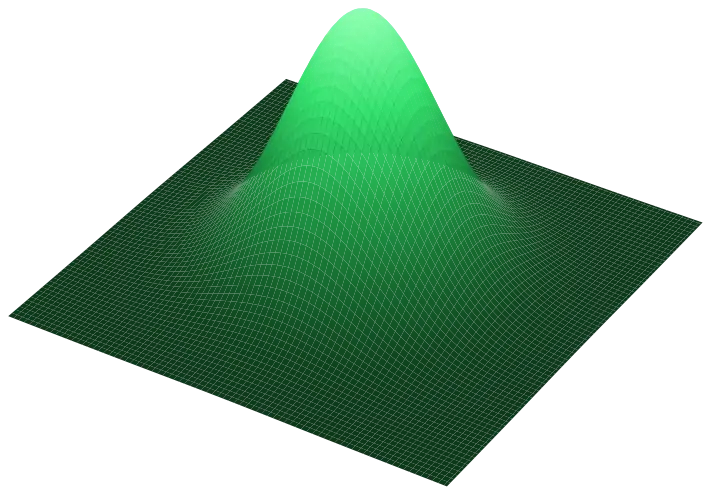
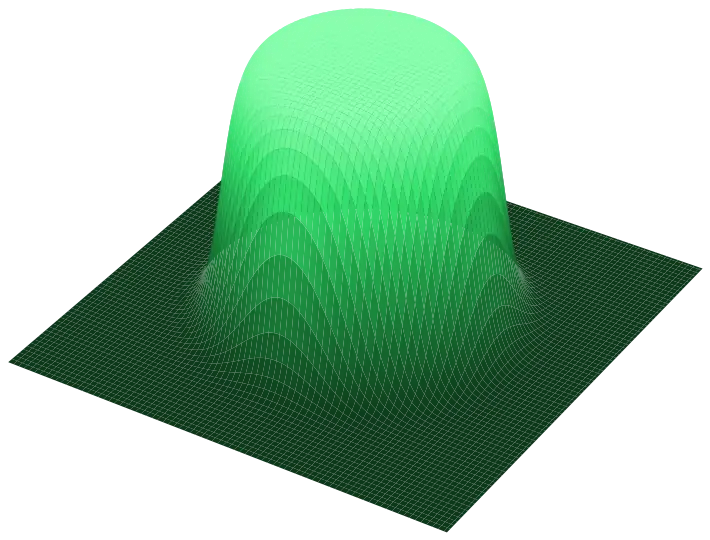
We shape a homogeneous flat-top for single-mode lasers, sized and shaped to your process. It converts a Gaussian into a uniform plateau from 1.5× to 10× the spot, round, square or rectangular, at exceptional efficiency. When you can hit the focal plane accurately, it’s the most flexible and efficient flat-top we make.
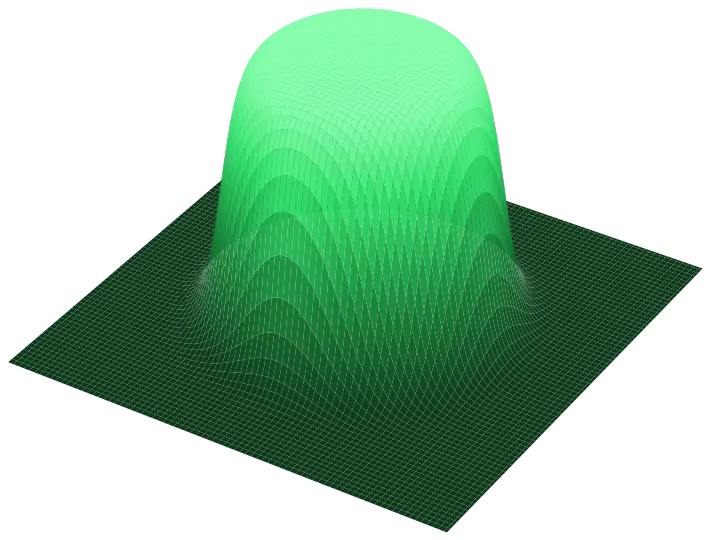
Uniform energy, exactly the size and shape you need
A raw Gaussian puts too much energy in the centre and not enough at the edges, so ablation, cutting and surface processes come out uneven. A flat-top replaces that peak with a homogeneous plateau, so every part of the spot does the same work. Ours comes shaped to your geometry as standard, round, square, rectangular or custom, anywhere from 1.5× to 10× the Gaussian spot, and delivers that at >90–95% efficiency: almost all your laser power ends up in the useful profile.
Flexible, efficient, all-reflective
Any size, any shape
A plateau anywhere from 1.5× to 10× the Gaussian spot diameter, in round, square, rectangular or custom geometry, built to your process rather than pulled from a catalogue.
Exceptional efficiency
>90% at 1.5× and >95% from 2× to 10× the spot, with <5% plateau non-uniformity (ISO 13694) and side modes under 1.5%. Almost all the power lands in the useful profile.
All lasers, all power
All-reflective, micro-structured mirror optics: deep-UV to near-IR, femto to CW, to 50 kW+. They stay stable at power, where transmissive optics drift under thermal lensing.
Optimized to your M²
Beam quality isn’t an afterthought here: every shaper is designed against your laser’s actual M², not a generic ideal M²=1.0. Matching it to your laser lets us push homogeneity to the best your system can deliver. Send us your M² and we design around it.
We individualize flat-top size, shape and wavelength to your beam and system as standard.
This 2D Top-Hat, or the 3D Top-Hat?
Both turn a Gaussian into a flat-top. The difference is where they win: maximum flexibility at focus, or maximum stability through depth.
Top-Hat Beam Shaper
Best when you can hit the focal plane. Free choice of size (1.5–10×) and shape (round, square, rectangular), at the highest efficiency (>90–95%). The flat-top is optimized right at focus, so your process needs good alignment and an accurately placed focal plane to get the full benefit.
- Any size 1.5–10× the Gaussian spot
- Round, square, rectangular or custom shape
- Highest efficiency, >90–95%
- Performs best in the focal plane
3D Top-Hat
Best when the process moves through depth. An EDOF-engineered flat-top that holds its shape across an extended axial range: a wider, more forgiving process window on the line. Fixed at a round 1.8×-diffraction-limited spot in exchange for that depth stability.
- Stable across an extended depth of focus
- Round profile, ~1.8× diffraction-limited
- Resistant to focus shifts & alignment on the line
- For production where the focus can’t be held exactly
Not sure which fits? Send us your laser, target profile and how tightly you can hold focus. We’ll recommend the right one.
Round, square or rectangular: at any size
The plateau geometry is a design choice, and it scales with your target size. These are simulated intensity profiles: red is peak intensity, blue the falling edge. At a small 1.5× plateau the edge (and its diffraction side-lobes) take up a larger share of the spot; scale up to 2–10× and the same edge becomes a thin border around a broad flat plateau.
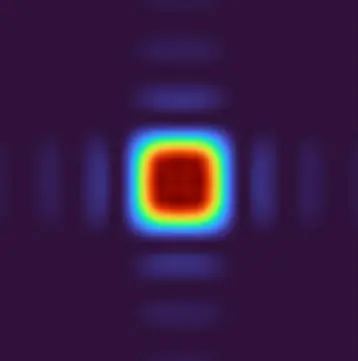


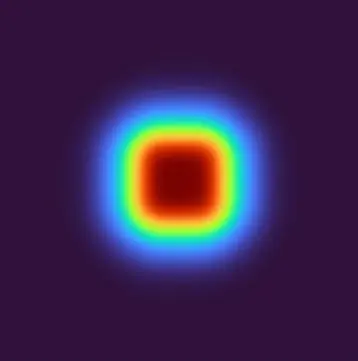
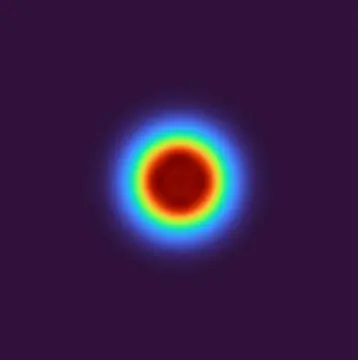
Other shapes and aspect ratios on request. Tell us the footprint your process needs and we design the profile around it.
Same edge, bigger plateau: why size sets the quality
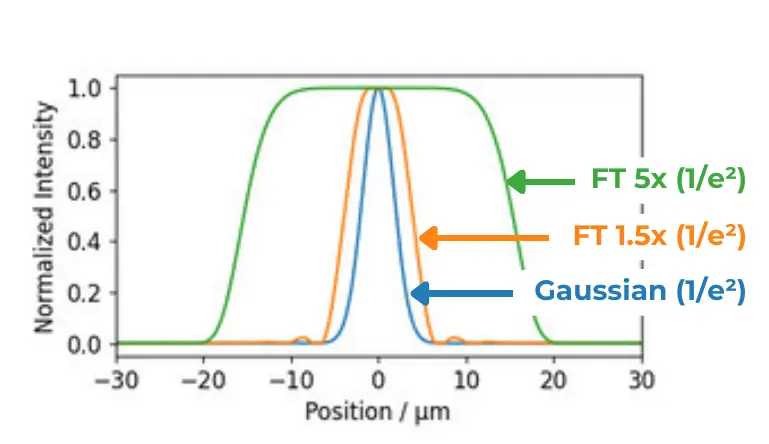
Think of a flat-top as a Gaussian cut through the middle, with a flat plateau inserted between the two halves. The rising and falling edges keep the Gaussian’s shape, because that edge is set by your optical system, and ultimately by the diffraction limit. Nobody can make it steeper; we insert the plateau, we don’t change the flanks.
So the edge width stays essentially fixed, while the plateau is whatever size you ask for. That’s why size sets the quality: at a large 5× plateau the fixed edge is only a thin border around a broad flat-top, but at a tight 1.5× the same edge takes up most of the spot and there’s barely any flat region left.
The rule of thumb
You can’t turn a 20 µm Gaussian into a clean 20 µm flat-top: the fixed edges would be as wide as the spot, leaving no plateau. To get a well-defined flat-top, either enlarge the input beam or shorten the focal length so the plateau is comfortably larger than the edge. Tell us your target size and we’ll tell you the beam or focal length it needs.
Will it fit your setup?
Every flat-top is matched to your laser, target profile and process. We design against the parameters below: send them and we confirm fit for your exact configuration.
Recommended setup: integrate into a collimated beam with a focusing lens. The flat-top is optimized at the focal plane; for setups without a lens, contact us for analysis.
Specifications
| Parameter | Characteristic |
|---|---|
| Flat-top geometry | |
| Flat-top size | 1.5× – 10× of Gaussian spot diameter (1/e²) |
| Shape | Round, square, rectangular or custom |
| Efficiency | >90% (1.5× Gaussian spot) | >95% (2–10× Gaussian spot) |
| Homogeneity | <5% plateau uniformity (ISO 13694:2018) |
| Strongest side modes | <1.5% |
| Depth of focus | Performs best at the focal plane — accurate focus positioning required. For a flat-top that stays stable across depth, see the 3D Top-Hat. |
| Input beam requirements | |
| Input beam | M² < 1.5; higher on request |
| Input beam diameter | Customized for beam diameter ±5%; max diameter 16 mm (AOI = 45°) |
| Wavelengths | 1064/1030 nm; 532/515 nm; 450 nm; 355/343 nm; 266 nm; others on request |
| Clear aperture | ≥ 2× beam diameter (1/e²) |
| Integration | |
| Alignment | Lateral alignment required; rotation not possible (for rotated structures, contact us) |
| Setup | Recommended: integrate into a collimated beam with a focusing lens. For setups without a lens, contact us for analysis. |
| Further specs | |
| Material | Micro-structured dielectric HR coating on fused silica substrate |
| Reflectivity | >99.9% @ 1064/1032 nm; 532/515 nm; 355/343 nm — >99.8% @ 266 nm |
| Dimensions | Ø25 mm/1″ and Ø50 mm/2″. Other dimensions on request. |
Datasheet v1.3. Values refer to a single-mode input and aberration-free optical system; system aberrations and beam quality may influence the achieved results. Exact performance confirmed per configuration.
It mounts like a mirror. It aligns like an optic.
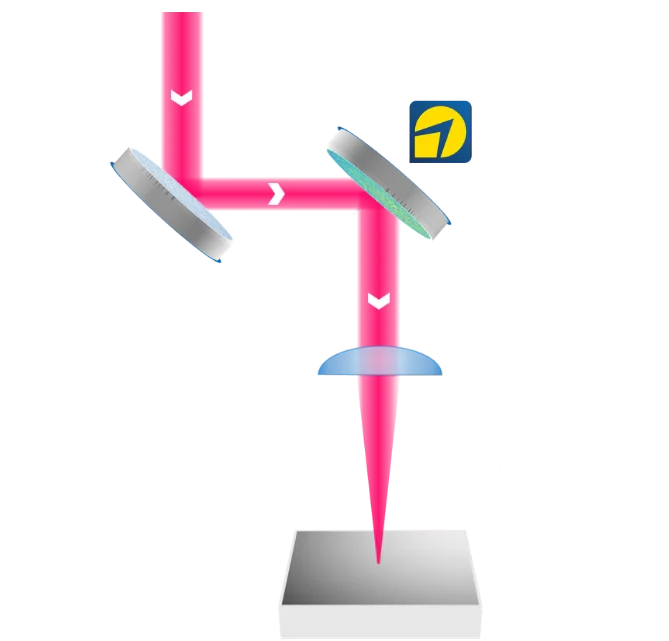
Parallel / Z-folded
Shaper with a folding mirror before the lens: any distance to the lens, focal length f to the part.
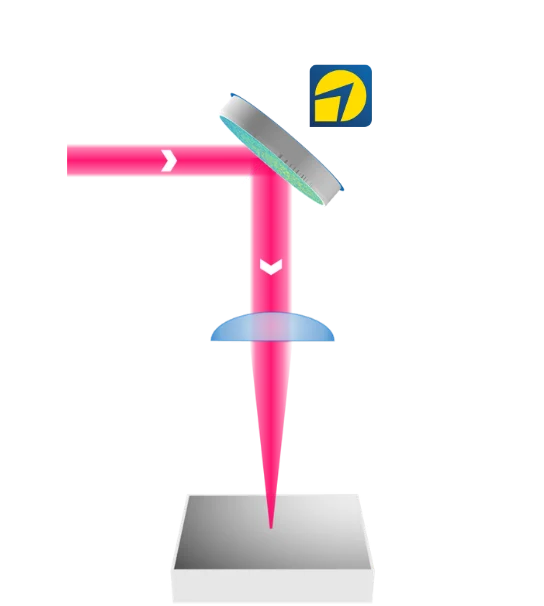
Folded: replaces a mirror
Shaper at 45° folds the beam straight into the lens: takes the place of a deflection mirror already there.
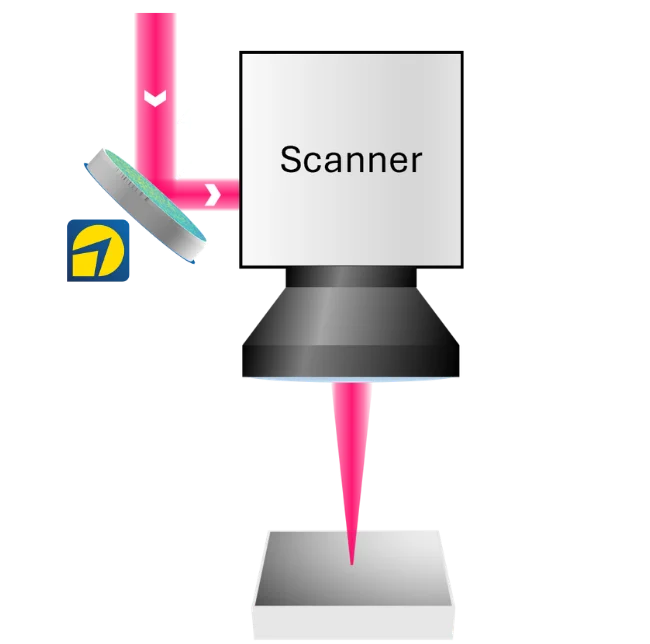
Scanner
Shaper ahead of the scanner and F-Theta lens: flat-top processing for scanned applications.
Other configurations and angles-of-incidence (AOI) available. Tell us your beam path and we’ll propose the cleanest integration.
Where it's used
Datasheets
Frequently asked questions
What’s the difference between the 2D and the 3D Top-Hat Shaper?
What size and shape can I get?
I have a 20 µm Gaussian spot. Can I get a 20 µm flat-top?
How efficient is it?
Does my beam quality (M²) matter?
Which lasers does it work with?
Why does the focal plane matter so much?
How do I integrate it?
Is a flat-top right for your process?
Send us your laser, target profile and how tightly you can hold focus. We'll confirm the right shaper for your setup, in your hands within three weeks.
Discuss your challenge